The short version for busy families
Lift chairs are expensive, Medicare is a big program, and many ads suggest it will pay. It might pay something, but the amount is small next to the price of the chair, and the bar to qualify is high. Here is the logic in three lines:
- Medicare treats a seat-lift mechanism as durable medical equipment (DME), covered by Part B.
- The chair around it is not covered: CMS tells suppliers to bill it separately as a non-covered item.
- Coverage needs a doctor's documentation of specific conditions, written before the chair is delivered.
SteadyHome Mobility, which sells the Journey chairs we review, sums it up in one sentence on its product page: Medicare "covers the lift mechanism in some cases, never the chair." That matches what the CMS documents say, which we walk through below.
What Medicare's own rules say
Three documents govern this, all on cms.gov. The national rule is National Coverage Determination 280.4, "Seat Lift". It allows payment for a medically necessary seat lift "when prescribed by a physician for a patient with severe arthritis of the hip or knee and patients with muscular dystrophy or other neuromuscular diseases", and adds that the severity must be such that "the alternative would be chair or bed confinement."
The detailed criteria sit in Local Coverage Determination L33801, "Seat Lift Mechanisms". All four must be met:
- Severe arthritis of the hip or knee, or a severe neuromuscular disease.
- The seat lift is part of the treating practitioner's course of treatment, prescribed to improve the condition or slow its decline.
- The person is completely incapable of standing up from a regular armchair or any chair in the home. The LCD is explicit that difficulty, even being unable to get out of a low chair, "is not sufficient justification".
- Once standing, the person can walk.
The LCD also asks the practitioner's record to show that other therapies, such as medication and physical therapy, were tried and did not enable the person to transfer from a chair to standing. And it excludes spring-release lifts that jolt the user up "with a sudden, catapult-like motion". The powered chairs we compare all use a motor.
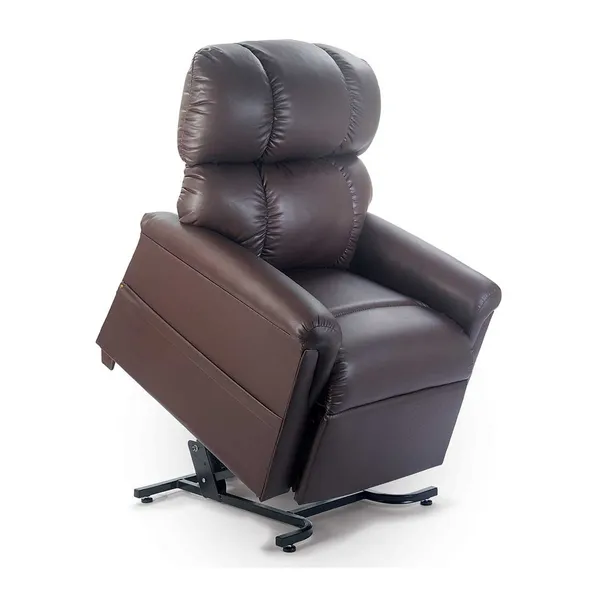
Our top-rated chair overall: lifetime warranty on the frame and the lift, six sizes, $1,793.
The codes your supplier will use
policy article A52518 explains the billing. An electric seat-lift mechanism is billed under HCPCS code E0627, a manual one under E0629. When the mechanism comes built into a chair, as in every lift chair, the supplier bills the mechanism under E0627 and the chair under A9270, the code for a non-covered item. That is the "never the chair" rule in practice.
Two more details from that article matter for families. First, the supplier needs a written order from the practitioner before delivery: "If a supplier delivers an item prior to receipt of a WOPD, it will be denied". Second, a toilet seat lift (E0172) is not covered at all. Pride's own lift-chair page phrases the overall picture carefully: "Depending on participant eligibility and medical necessity, Pride Lift Chairs are qualified for partial reimbursement under certain Medicare, Medicaid and private insurance programs."
What you will actually pay
Medicare's booklet on equipment, Medicare Coverage of Durable Medical Equipment, says it plainly: "Generally, you pay 20% of the Medicare-approved amount after you pay your Medicare Part B deductible for the year." It also says Medicare covers equipment "if you get it from a supplier enrolled in Medicare", and that your costs may be higher if the supplier does not accept assignment.
Put that together for a lift chair. Medicare's share applies to the approved amount for the mechanism only. You pay your 20% of that, plus the whole price of the chair part. Allowed amounts vary by region and change over time, so ask the supplier for a written quote that shows the E0627 line and the A9270 line separately. If the chair you want costs $1,800 and the covered part is a few hundred dollars, Medicare changes the bill, but it does not make the chair cheap.
For scale, the chairs we compare cost $599.99 to $3,299 on November 11, 2026, with the most popular infinite-position models between $1,485 and $2,040. See our lift chair price guide.
How to try, step by step
- Talk to the treating doctor first. Ask plainly whether your parent meets the four criteria above. If the honest answer is "they struggle but can get up", Medicare will most likely say no.
- Get the written order before anything ships. The supplier must have it before delivery, or the claim is denied.
- Use a Medicare-enrolled supplier that accepts assignment. Ask: "Do you accept assignment for E0627?" Online retailers that sell for cash often do not bill Medicare at all; SteadyHome, for example, says "we do not bill insurance for anything we sell".
- Get a written quote with the mechanism and the chair on separate lines, and your expected share.
- Medicare Advantage? Call the plan: Advantage plans cover what Original Medicare covers, but can use their own suppliers and approval rules.
If you do not qualify, two other routes are worth a call: HSA or FSA money (SteadyHome says its chairs are HSA/FSA eligible with most plans), and your state's Medicaid or aging services office, which may have programs Medicare does not.
If Medicare says no: choosing without overspending
Most families end up paying for the chair themselves. In that case, put the money where it matters for daily life: the right size, a warranty that covers the lift motor for years, and battery backup. Our ranking for elderly parents weighs exactly those. On a budget, the Pride Evolution ($1,335) comes in six sizes with a 7-year pro-rated warranty, and our lift chairs under $1,500 list has five options.
Nothing here is medical advice. Talk to your doctor or physical therapist about what a lift chair should do for you, and follow the maker's instructions.
Our three picks for this guide
Scores come from our published formula; the full list is in the ranking.